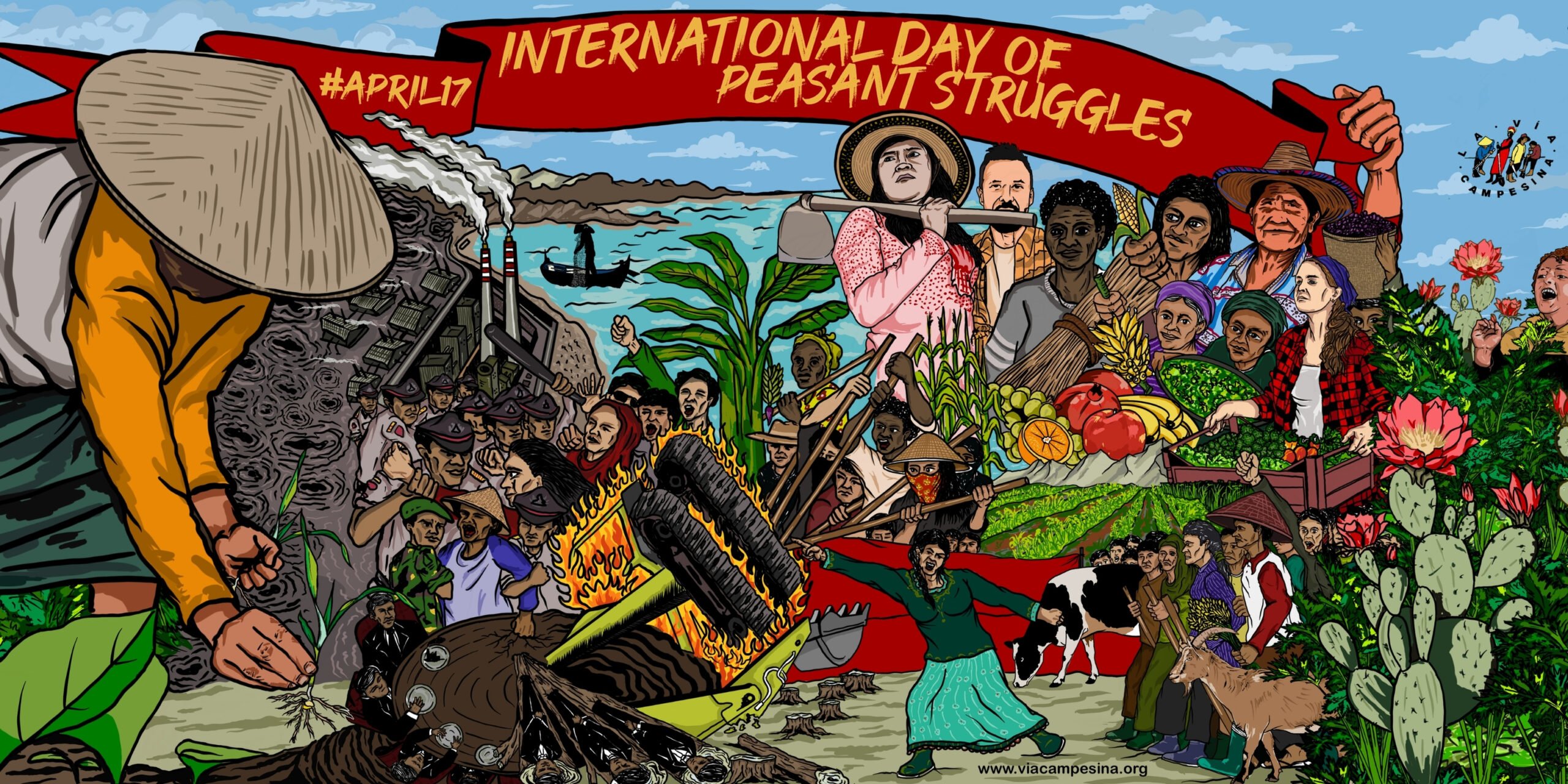
For a World Free from Violence and War: #April17 International Day of Peasant Struggles
On April 17th, the National Farmers Union of Canada (NFU) joins the global La Via Campesina movement’s calls to action for the International Day of Peasant Struggles. Each year on this day, small- and medium-scale farmers, peasants, fisherfolk, landless and migrant workers, Indigenous Peoples, women, youth and gender diverse peoples from the global La Via Campesina movement honour the lives of 19 landless farmers who were assassinated in Eldorado dos Carajás, Brazil for defending their right to land. Thirty years later, we continue to denounce the intensifying, violent attacks on our communities perpetrated by the world’s oligarchs — wealthy individuals and their corporations — and supporters in governments.
Oligarchs and their political allies seek to dominate world politics and economies to satisfy their endless greed. They do so by subjecting small- and medium-scale farmers to policies and technologies that remove them from the land, limit their access to resources and destroy their livelihoods. These corporate outlaws promote technologies that undermine food producers’ traditional knowledge and skills. While trade in agriculture and food has never been “free,” it is increasingly evident that food economies and political institutions globally are being captured by oligarchs. Recent cuts to publicly-funded agricultural research programs in Canada show that these attacks are systemic and widespread, not isolated incidents.
Wars and fossil-fuelled economic growth that accelerate climate breakdown benefit the oligarchs who profit from the destruction which they are causing. The US-backed Israeli government’s genocide in Palestine demonstrates the brutality and lawlessness of the current world system. In Cuba, after decades of resistance to US government aggression, people are confronted by an inhumane military blockade that is seeking to restore the power of land-hungry oligarchs. In Venezuela, petro-oligarchs have backed a military incursion and, as with Iran and Lebanon, the lives of civilians and their food sovereignty are being sacrificed to imperialist geopolitical strategies.
In Canada/Turtle Island, because farming takes place on land from which Indigenous peoples have been displaced and robbed of their food sovereignty, settler-colonialism continues to perpetuate injustice. While the language of reconciliation is frequently invoked, implementation of the United Nations Declaration on the Rights of Indigenous Peoples (UNDRIP) falls short or does not occur at all, particularly in the face of large-scale resource projects. In Mexico, Ecuador, Congo and West Papua, the human rights violations committed by Canadian corporations are also well-documented.
While Canada presents itself as a defender of human rights, in practice, our government is supporting policies that align with global corporate interests. As we have emphasized, governments have a responsibility according to the provisions of the United Nations Declaration on the Rights of Peasants (UNDROP) to ensure that entities whose actions they are in a position to control — such as Canadian corporations — respect human rights and Indigenous rights.
In contrast, people around the world are standing in solidarity and coordinating across borders and social movements for justice and peace. Small- and medium-scale food providers are an integral part of these struggles. Agroecology, grounded in food sovereignty, represents the most direct challenge to the ambitions of oligarchs and their compliant governments. While 1 percent of large-scale industrial farmers control 70 percent of the world’s arable land, small- and medium-scale farmers and peasants cultivate 12 percent of the world’s agricultural land while producing 35 percent of the world’s food, and they are doing so in ways that are more humane, resilient and sustainable.
2026 is the “International Year of the Woman Farmer”. Women farmers and farm workers are at the forefront of community efforts to defend food systems that protect life. By focusing on the wellbeing of people and nature, women’s campaigns for food sovereignty reaffirm the importance of care, the solidarity economy and forms of participatory democracy that encourage us to share power rather than wield it as a weapon. These efforts strengthen resistance to the influence of the oligarchs.
By linking local and global struggles for justice, peace, food sovereignty, feminism and ecological sustainability, the existing power system that favours the few can be transformed to benefit the many. We are connecting with one another to defend Indigenous land sovereignty and place meaningful agrarian reform front and center. For us, land is not a commodity, it is a source of life. We are fighting to maintain the government institutions and regulations that protect community wellbeing and health and stop the greed of the oligarchs.
On this International Day of Peasant Struggles, and in recognition of the International Year of the Woman Farmer, the NFU expresses deep solidarity with the member organizations of La Via Campesina to advance our shared vision for food sovereignty, land justice and a world free from violence and war.
For the self-governance and dignity of our peoples : Resist, cultivate, transform ! Globalize the struggle, globalize hope!
For more information, please contact:
- Ayla Fenton (ipccoordinator@nfu.ca)
