
Owen Schalk is a writer from Manitoba, Treaty 1 Territory. Born 1998 in Winnipeg, MB. Owen’s books include Canada in Afghanistan: A story of military, diplomatic, political and media failure, 2003-2023 (Lorimer, 2023), Targeting Libya: How Canada went from building public works to bombing an oil-rich country and creating chaos for its citizens (Lorimer, 2025), and Canada & NATO: The Myth of a Global Peacekeeper (ARP Books, 2026). He is a columnist at Canadian Dimension, and he has written for many other publications including Canada‘s National Observer, Jacobin, The Maple, Monthly Review, and the North American Congress on Latin America (NACLA).
To get a sense of Owen’s fiction work, check out “Speaking in Regrets,” which won Humber Literary Review‘s 2024 Emerging Writers Fiction Contest, and “She’s a Beauty,” published by Vast Chasm Magazine in summer 2023.
Owen is a member of the Manitoba-Cuba Solidarity Committee and Cat’s Cradle (Tiger’s Eye), a proletarian internationalist organization with comrades in Burkina Faso, Kenya, Panama, and Palestine.
Wintering Bees
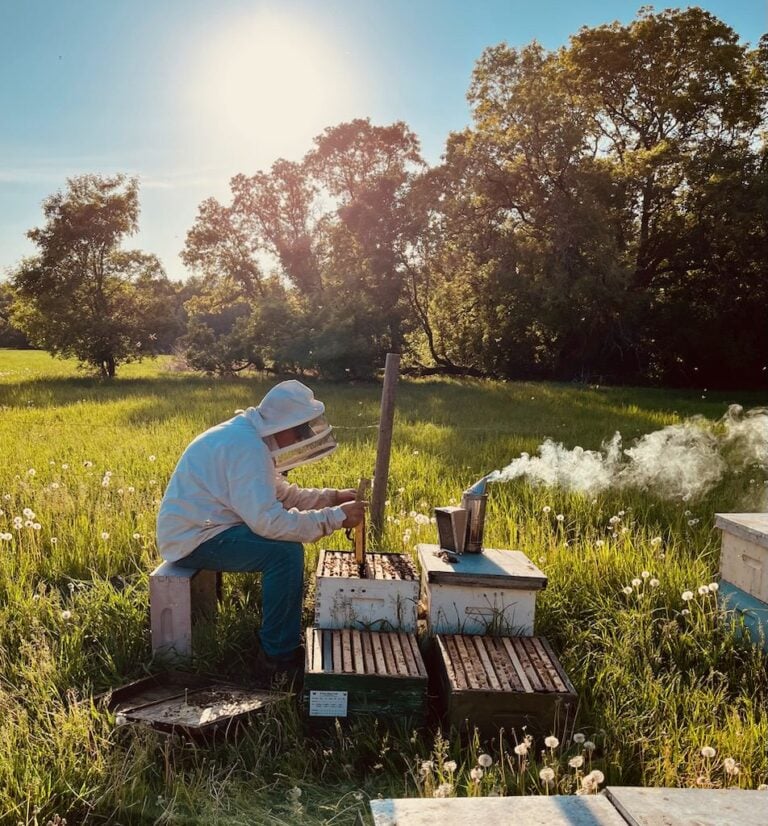
The flatbed work truck, a rusty Ford with fickle brakes, rattles down the gravel road toward our bee yard. My dad and I are jammed into the cab. It’s late October, and we’re preparing to winter the hives. Outside, fields roll past. We still call them by the names of the families that used to own the land, not the mega-farms that own them now.
For farmers, there is a trepidation associated with the future. Agriculture is a profession uniquely vigilant about changes in markets, swings in the temperature. Not long ago, my father told me a story about unexpected rain washing away his dad’s stooked wheat, clogging the culverts, flooding the backroads around his section and costing the family who-knows-how-many dollars. In early 2022, meanwhile, our hives were buried under a flash April blizzard. These are the daily uncertainties. Nationally and internationally, changes in the economic weather, in the policy-making climate, also shape the future of Canadian farmers – and farmers everywhere. These changes can be just as catastrophic as a deluge of snow for a slowly awakening beehive.
I grew up in a rural area, but I don’t remember any kids my age wanting to be farmers. They chose more pragmatic paths, computer science or engineering, or tried to find success as internet celebrities of various kinds – lifestyle influencers, video game streamers, et cetera – a dream that only seems to have grown in popularity since I graduated high school in 2016.
The average age of the Canadian farmer is now 56 years. Why would young people want to farm? Land prices are prohibitively high, as are input costs. As a result, Canada’s food system has become dominated by mega-farms – the average Canadian farm size in 1971 was 310 acres, but by 2021, it had almost quadrupled to 1200. These mega-farms rely on industrial inputs and seasonal labour to sustain productivity. Smallholder farmers find it increasingly difficult to compete. Statistics reflect this reality: as farm size grows, the number of farms across the country plummets.
My family has kept bees for fifteen years. Before that, we had pigs. When Manitoba had the Hog Producers Marketing Board, or the “single-desk” selling system, things went well for smallholder pig farmers. Any large companies that wanted to buy pork from Manitoba producers had to go through the Marketing Board, which was a collective bargaining win for hog farmers: it meant that even small-scale hog operations would have a guaranteed buyer for their pork at a set price.
In 1996, the Filmon government repealed the single-desk model, ending the government’s monopoly over pork. This allowed massive corporations like Maple Leaf Foods to negotiate lower prices for pork from farmers. It put small family farms at the mercy of the market. My grandfather often said the end of the single desk was the end of our hog farm.
We weren’t alone. Across Manitoba, family pig farms vanished in the aftermath of the single-desk privatization. The Canadian government terms this process “farm consolidation,” as though it’s an inevitability, but in reality, it’s the result of government ideology and policy designed to maximize farm size and productivity at the expense of smallholders, farm workers, and the environment. On the ground, farm consolidation means depopulation, degraded social services, and young farmers abandoning agriculture in search of new ways to guarantee their financial security. Barriers to land access and farming equipment grow every year, and these walls are much higher for people of colour and marginalized groups, especially Indigenous peoples.
The flatbed lopes down an overgrown road into a thicket of maples, what we call the marsh yard. We crack open hives, survey the humming welter of honeybees for indications of ailment or health. When I was twelve years old, my dad took me to our first bee yard to show me a queen. At the time, I was deathly bored. I just wanted to return home and continue playing video games or watching Supernatural, but when he held up a frame, pointed through the madly vibrating drones to the queen dragging her long gold thorax over comb, a curiosity bloomed inside me. As I grew older, I became increasingly fascinated with the lush sensory world of the bee yards – their solitudinous toil, their calming drone. The agricultural world began to sing like never before, but at the same time, I became attuned to its sickness. The bee population is at risk – some years we contend with 70 percent winter losses. Beekeepers constantly worry about pesticide use imperiling the health of their hives. Beekeeping is unique in that the number of beekeepers in Canada actually grows each year; however, if the risks continue, I suspect that young beekeepers will drop off like underfed drones, as they have in other industry sectors.
Across the world, farmers fight for food sovereignty, local control over food systems, and a just farmland future – in La Via Campesina, the Landless Workers’ Movement in Brazil, and elsewhere. The Canadian fight for an equitable and sustainable agriculture is part of this global struggle. As Canadians, we must envision a future model of agriculture in which rural youth are motivated to engage in agriculture, to view farming as socially necessary labour that is integral to their personal fulfillment. We must fight to reverse rural depopulation and increase land access. We must promote sustainability over ever-increasing fossil fuel use and chemical applications. We must endorse policies that will build a robust and populous countryside while erasing the barriers that have historically excluded marginalized groups from agriculture. These are not pipe dreams: they are the bare minimum for ensuring the future of Canadian agriculture.
In the marsh yard, my dad and I load the hives onto the flatbed, weighing each one with our yellow-armed Apijuneda crane. Some hives encourage us; others disappoint. Driving home, I wonder how many will survive the winter, if my own children will ever get to experience the wonderment of first glimpsing a queen.
