
The following is the NFU’s Brief to the Standing Committee on Agriculture and Agri-Food Committee Study on Science in Canadian Agriculture and the Closure of Research Centres.
The impact on farmers of the federal government’s decision to close multiple Agriculture and Agri-Food Canada research centres and experimental farms and the Organic and Resilient Agriculture program
Our food and agriculture system is facing serious challenges – including climate change, geopolitical instability, biodiversity loss, rising inequality and unpredictable trade relationships. A robust public plant breeding system is a key strategy to reduce food system risk and develop the resilience we need for a successful future.
The seven research facilities – at Lacombe, Indian Head, Scott, Portage la Prairie, Guelph, Quebec City and Nappan — and the Organic and Regenerative Agriculture program, and the scientific, technical, skilled labour and administrative staff that work there to carry out and support public agriculture research, are essential elements of a sophisticated, integrated system of research that provides immense value, exponentially greater than their annual operating budgets. The embodied value of the research facilities cannot truly be measured, because much of it is irreplaceable. Continuous data from research plots that extends back over 140 years can never be recreated. Multiple millions of dollars have been invested in buildings including purpose-built laboratory facilities, equipment ranging from custom small-plot seeding and harvesting machines to precision laboratory instruments, and biological materials including unique collections of insects, disease inoculum and germplasm, and land representative of multiple soil and climatic regions. The scientists and technicians whose positions are being cut represent thousands of years of publicly funded education and knowledge created and developed through their careers. These cuts amount to a self-inflicted brain drain, and a disincentive for young people interested in agricultural science fields.
Serious irreversible harm will occur if these cuts proceed.
The research institutions on the chopping block are key components of Canada’s original nation-building infrastructure. In 1885, the House of Commons asked Dr. William Saunders to visit the USA and Europe, study their experimental stations, and recommend a framework for agriculture research in Canada. He proposed a network of experimental farms, each focussed on a geographic region, to study its crops, conditions and farming challenges. Parliament passed an Act the following year, establishing five farms, including the Indian Head and Nappan research farms.[1] Lacombe Research Centre was added in 1907, Scott Research Farm in 1911 and Swift Current in 1920. In 1925, the publication The Dominion Experimental Farms, described Canada’s system as “the most comprehensive of its kind to be found in the world.” Building upon that foundation, the Portage la Prairie research farm was set up in 1944, Quebec City Research Center in 1967 and the Guelph Research and Development Centre opened in 1997.
These facilities represent well over a century of strategic public investment and embodied knowledge. They also provide a base for research supported by farmer check-off dollars allocated to projects by crop commissions. Closing them will reduce the scope of farmer-directed research, and reduce the returns to farmers from their levy payments.
Plant Breeding
One of the most valuable research investments made by AAFC, and augmented by farmers, is in public plant breeding. Wheat midge resistant wheat is one example.
Wheat midge is an introduced pest, which became widespread across the prairies by the early 1980s. Larvae feed on immature wheat kernels. Affected fields consistently suffer 50% yield loss, which can go up to 90%[2]. The main insecticide available for wheat midge control was Chlorpyrifos, deregistered due to harmful health and environmental impacts in 2020 and is now prohibited. The remaining insecticide option has a narrower window for application, increasing costs and limiting its effectiveness.
In 1996 AAFC researchers at the Cereal Research Centre in Winnipeg (closed in 2014 under the Harper government’s research cuts) discovered a variety of soft white winter wheat that was resistant to midge, and began to study it. They found it had one gene that would cause the plant to produce a chemical toxic to the midge larvae when attacked — the midge would then stop feeding and die. Once the midges are gone, the plant stops producing the chemical, so there is no impact on the quality of the mature wheat kernels.
Through traditional breeding techniques, AAFC scientists were able to breed a hard red spring wheat – the kind used to make bread, and most widely grown on the prairies – that has midge resistance. It was commercially released in 2010. Seed is sold in bags that contain 10% midge-susceptible varieties to ensure that susceptible midges survive in small populations and do not evolve resistance.
Canadian wheat breeders have since developed 45 midge resistant wheat varieties, encompassing all Western wheat classes. From 1997 to 2019, $16.3 million in public and farmer funding has been invested to develop midge tolerant wheat, with an estimated a 37:1 dollar return on value via reduced costs and increased yields. In addition, farmers who use wheat midge varieties no longer have to spray for wheat midge, which reduces their costs and has environmental and health benefits.
Midge populations are falling as a result of farmers planting these varieties, so even those who don’t buy midge resistant seed are protected as a result of their neighbours using it. This is just one example of publicly funded research producing widespread public benefit.
The wheat midge resistant wheat success story could only occur within our publicly funded network of research institutions dedicated to producing results for farmers. The planned AAFC cuts will not only prevent future breakthroughs of this magnitude, but they also threaten the future value of wheat midge resistance because the wheat midge tolerance stewardship program is housed at the Indian Head Research Station, slated for closure. Susceptible strains of the wheat varieties are produced from Breeder seed grown there to supply the 10% of susceptible seed for each bag of seed. Without this, midges will quickly evolve tolerance, destroying the value of wheat midge resistant varieties.
The wheat midge success story also resulted from AAFC research extending all the way to the variety finishing stage. 32 of the 45 midge tolerant varieties now on the market were developed by AAFC breeders (8 are from the University of Saskatchewan’s Crop Development Centre, and 4 are from private companies, all using AAFC-developed material)[3]. This contrasts with canola, where AAFC does upstream research, but no longer finishes varieties. AAFC finished just 9 out of 660 currently registered canola varieties, and none since 2009[4].
AAFC’s retreat from variety finishing in canola is preventing development of commercial hairy canola varieties. In the 1980s an AAFC insect scientist discovered that flea beetles, a serious insect pest of canola, do not feed on a weedy relative of canola known as wild mustard.[5] Wild mustard has tiny hairs. Flea beetles are a serious problem in canola. They overwinter as adults and feed voraciously in early spring. Vast fields of emerging canola seedlings are a perfect food for them. To prevent severe losses, farmers have had to use pesticides. Lindane, a probable carcinogen, was used as a canola seed treatment until it was banned in 2004. Today, virtually all canola seed in North America is treated with a neonicotinoid insecticide, which in 2018, Health Canada had proposed to phase out due to unacceptable impacts on aquatic ecosystems and bird life.
By 2014, AAFC scientists had developed both genetically modified and conventionally bred strains of canola with the hairy trait. It not only prevented flea beetle damage to seedlings, its hairiness also protected it from early frost, an increasing risk due to climate change.[6] Commercializing hairy canola would reduce farmers input costs and protect biodiversity by reducing pesticide use on millions of acres. If farmers had access to hairy canola, they might have saved millions of dollars on insecticide, seed treatments and gained income due to better seedling establishment and higher yields. However, canola variety finishing has been privatized, and the companies selling canola seed also sell pesticides and seed treatments. Solving the insect pest problem would reduce their input sales, so it is not in their interests to finish hairy canola varieties. If farmers had access to hairy canola, they might have saved millions of dollars on insecticide, seed treatments and gained income due to better seedling establishment and higher yields.
The contrast between the success of AAFC midge-resistant wheat varieties and the private sector’s failure to finish and commercialize hairy canola varieties demonstrates that increasing Canada’s reliance on the private sector for plant breeding will prioritize their short-term commercial interests at the expense of resilience and farmers’ interests at a time when these are increasingly urgent needs.
The Organic and Regenerative program at Swift Current is Canada’s only site for registration trials for cereal crop varieties developed for organic and low-input production systems. These trials require organically managed sites to obtain valid results. Shutting down the program will likely result in destruction of these plots. Eliminating testing under organic conditions will deprive organic farmers of data needed to choose the best variety for their farms, and will likely result in less breeding for organic production. The loss of this research could have much further-reaching consequences. If economic conditions and/or supply chains restrict access to fertilizer and chemicals for manufacturing pesticides, or certain weeds become multi-resistant to pesticides, non-organic farmers will also benefit from varieties developed for organic production.
The Quebec City research center houses the germplasm/seed collection developed by retired AAFC wheat breeder Andre Comeau during his long career. His work focused on fusarium head blight resistance, another serious cereal crop disease with major impacts on yield and quality. The collection is an important plant breeding resource that must be maintained.
The announced cuts, if implemented, will seriously compromise AAFC’s plant breeding capacity. In early January, AAFC wheat breeder Richard Cuthbert, whose breeding program is responsible for more commercial acreage than any other wheat breeding program in the world, resigned due to frustration with the lack of adequate institutional support for effective breeding work. Tens of thousands of small research plots distributed across a wide range of soil types, disease and insect pressures, and climatic conditions are needed to test potential new varieties. Pathologists must screen each potential new variety against diseases in natural field conditions to ensure it has adequate resistance. What makes a successful variety is the combination of genetics, agronomic practice and environment. These real-world conditions are specific to the regional soils and climate, and cannot be reproduced in a laboratory or greenhouse, or modelled with Artificial Intelligence (AI). Lacombe, Indian Head, Scott, Portage la Prairie, Quebec, Nappan, and the Swift Current Organic program currently provide a large proportion of the small plot capacity for AAFC breeding work. Removing them from the system will seriously harm, and potentially destroy Canada’s public plant breeding capacity.
Seed production
The Indian Head Research Farm houses the national Seed Increase Unit, which is responsible for maintaining all AAFC developed varieties as Breeder Seed other than soybean, dry beans and some eastern cereals. The Seed Increase Unit safely stores and protects the genetic integrity of Breeder Seed for over 300 varieties across more than 30 crop types including cereals, oilseeds, pulses, forages, and special crops. From it, Indian Head produces quantities of seed large enough to distribute to pedigreed seed growers, who then grow enough certified pedigreed seed for farmers to purchase and grow commercial crops. This is a critical step in taking the finished variety to commercial production. It is integral to Canada’s international reputation for quality, which translates into the ability to obtain higher prices in export markets. The Seed Increase Unit is ideally located at the Indian Head Research Farm. Its Class 1 soil and moderate prairie climate provide growing conditions amenable to the range of crop types with low risk of failure, and capacity to manage extended crop rotations to maintain health and purity of seed.
Closing Indian Head Research Farm makes no sense. Replacing its facilities would be many times more expensive than maintaining them; there is no better location for the Seed Increase Unit – moving it would increase ongoing costs and risks without improving output, and offloading the work onto another entity would risk compromising the integrity, introducing conflicts of interest, and/or adding inspection and administrative costs.
AAFC varieties are very successful commercially. AAFC varieties comprise nearly 90% of acres planted to our most valuable export, hard red spring wheat. The Saskatchewan Seed Guide 2026 shows that over 3/4 of all wheat acreage, and nearly 2/3 of the total acreage of commercial production comes from AAFC varieties—as reported for crop insurance purposes in B.C., Alberta, Saskatchewan and Manitoba.
Loss of any public plant breeding capacity could not come at a worse time. Climate change is advancing relentlessly, rapidly changing growing conditions, changing the range and behaviour of pests, weeds and diseases, affecting frost dates, moisture regimes, heat, snow cover, and relationships with non-agricultural biodiversity. Geopolitical instability affects cost of production by interrupting supply chains, destabilizing currency exchange rates and tariff regimes, and adding production risks from weakened trading partners’ phytosanitary regulatory capacity. Maintaining, indeed expanding, our public plant breeding capacity will provide a buffer against these risks by giving Canada as a whole, and farmers particularly, greater capacity to continue producing affordable food for Canadians and competitive products for export, while providing a fair income for farmers.
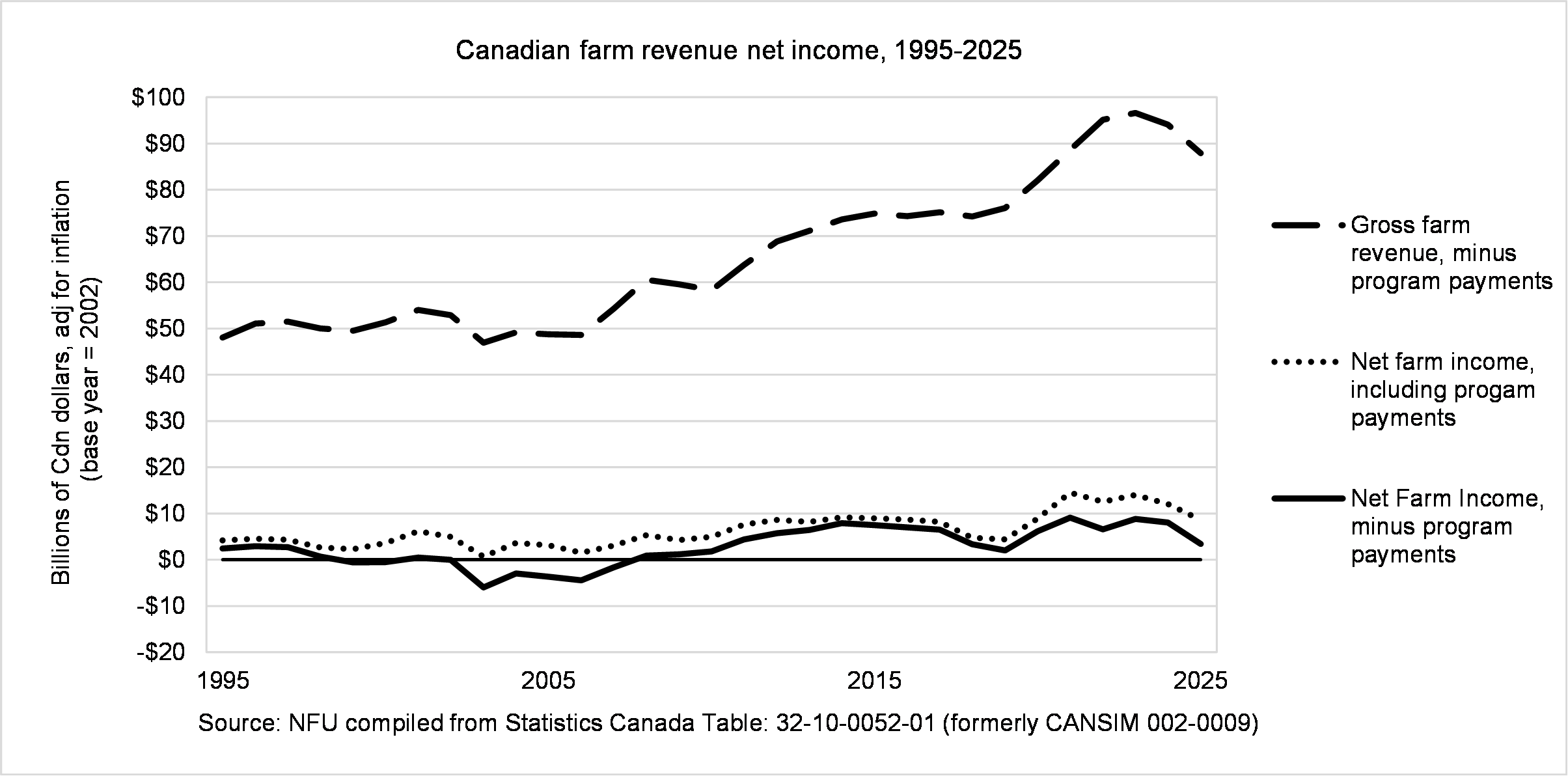
Farmers are also struggling economically. Realized net farm income is down, commodity prices are down and expenses are climbing.[7] Seed expenses are going up.[8] Compromising AAFC public plant breeding capacity will slow the rate and reduce the volume of useful new varieties released, and increase the risk of producing varieties that are less suited to various growing conditions and more susceptible to disease and pest pressure. Less suitable varieties increase farmers’ production costs. Rising production costs makes farmers increasingly reliant on Business Risk Programs, total farm debt is now over $170 billion[9] – while total farmer numbers keep going down[10].
Offloading plant breeding to the private sector and/or universities will lead to higher seed costs for farmers and less value to the broader public. Universities need to at minimum recover costs, and for-profit seed companies need a return on investment. This is likely to occur through higher royalty payments and restrictions on using farm-saved seed so that more farmers must buy seed every year, increasing annual seed costs even more. Smaller acreage crops such as flax, condiment mustard, chickpeas and camelina, and perennial forages such as alfalfa, cannot provide enough return to cover breeding costs without access to AAFC’s infrastructure. Lack of breeding for these crops will make our agriculture system more brittle, with fewer choices for farmers and less biodiversity. If the planned cuts to AAFC research proceed, especially in plant breeding, farmers will be paying more and getting less.
Who funds and makes decisions about plant breeding, and who controls the commercialization of new varieties affects the land, livelihoods, economy, community, biodiversity and future prospects of farmers. The AAFC research network provides widespread public benefits that ripple outward to not only support the prosperity of farmers, but to safeguard the stability of our ecosystems, and the intrinsic value of nature in Canada.
AAFC’s public plant breeding system is a success story stretching over 140 years. It builds upon the history of traditional variety development by farmers since the agricultural revolution 10,000 years ago. It can have a strong future as well. Public plant breeding is an extremely efficient use of government dollars. Economist Richard Gray’s research shows that the government investment of $370.6 million between 1995 and 2020 resulted in a cumulative benefit to the Canadian economy of $11.8 billion, and every dollar of wheat investment from governments returned $31 to Canadians. When producer contributions through joint funding efforts were factored in, the return rose to over $70 Farm income, 2024 (revised data) [11].
Closure of key research farms and facilities at Lacombe, Nappan and Québec, and loss of staff, will do long-term damage to forage breeding, permaculture trials, carcass grading, and the development and trial of critical practices (including grazing trials) that will enable small and mid-scale mixed farms and cow-calf operations to adapt to changing climate realities and maintain sustainable livestock production.
Our nation-building predecessors developed a strong foundation based on a vision of widespread prosperity for all kinds and sizes of farms and for improvement of farms in every part of our vast country. We are standing on the shoulders of giants today, but an ill-considered decision to remove key elements of our research system to meet arbitrary budget savings risks toppling the giant and throwing our future into the hands of a patchwork of entities without a mandate or shared vision to serve Canadians.
We Recommend:
- Immediate suspension of closures and employee terminations and reversal of planned cuts.
- Commit to rebuilding robust AAFC public plant breeding capacity including filling vacant positions/re-hiring terminated scientists and technicians, retaining all land used for small plot research and variety testing
- Reinstate the Organic and Regenerative Program at the Swift Current Research Station
- Provide full transparency regarding the decision-making process leading up to announcement of the cuts, including public disclosure of any impact analysis done by AAFC and the Parliamentary Budget Office;
- Meaningful engagement with farmers and farm organizations to develop a long-term strategy for Canada’s public agricultural research infrastructure in the interests of producers.
The National Farmers Union is an organization of, and for, farmers and farmworkers in Canada, working together to democratically achieve agricultural policies that ensure dignity and income security for farmers and farmworkers while protecting and enhancing rural environments for future generations.
[1] The Dominion Experimental Farms: A system of experimental stations operated by the Federal Government which investigates agricultural problems and is capable of giving continuous service to Canadian farmers, Printed by Authority of the Hon. W. R. Motherwell, Minister Of Agriculture Ottawa – 1925 https://atrium.lib.uoguelph.ca/server/api/core/bitstreams/e4fd40c6-3c02-4fcc-be1b-24be48389f64/content
[2] Wheat Midge: Enhanced Surveys and Wheat Resistance Traits to Preserve the Sm1 Gene, Tyler Wist, research scientist in field crop entomology with Agriculture and Agri-Food Canada at the Saskatoon Research and Development Centre, Canadian National Wheat Cluster https://wheatresearch.ca/wp-content/uploads/2025/03/Activity-17-EN-Canadian-National-Wheat-Cluster-FINAL.pdf
[3] Variety List, Midge Tolerant Wheat Stewardship Team website, https://midgetolerantwheat.ca/
[4] Varieties of Crop Kinds Registered in Canada, Canadian Food Inspection Agency https://active.inspection.gc.ca/netapp/regvar/regvar_lookupe.aspx
[5] Hairs Protect Pods of Mustard (Brassica Hirta .Gisilba’) From Flea Beetle Feeding Damage, By R. J. LAMB Research Station, Agriculture Canada, 195 Dafoe Road, Winnipeg, Manitoba R3T 2M9. Contribution no. 935, received 19 Feb. 1980, acceptedT May 1980 https://www.nrcresearchpress.com/doi/pdfplus/10.4141/cjps80-200
[6] Sask. flea beetles in ‘hairy’ situation, By Justine Cleghorn, May 20, 2013, PANow https://panow.com/2013/05/20/sask-flea-beetles-in-hairy-situation/
[7] Farm income, 2024 (revised data), Component of Statistics Canada catalogue no. 11-001-X, Statistics Canada, Wednesday, November 26, 2025 https://www150.statcan.gc.ca/n1/en/daily-quotidien/251126/dq251126a-eng.pdf?st=XatleVGB
[8] Source: Statistics Canada. Table 32-10-0136-01 Farm operating revenues and expenses, annual
[9] Statistics Canada. Table 32-10-0051-01 Farm Debt Outstanding, classified by lender (x 1,000)
[10] Statistics Canada. Table 32-10-0381-01 Characteristics of farm operators: Age, sex and number of operators on the farm, Census of Agriculture, 2021
[11] The Benefits and Costs of Producer and Public Investments: Wheat Varietal R&D in Western Canada 1995 to 2020 Katarzyna Bolek-Callbeck and Richard Gray1 University of Saskatchewan March 2022 https://saskwheat.ca/wp-content/uploads/2024/05/FinalBenefitsandCostsWheat2022.pdf
