
Why I’m Suing Canada’s Largest Pension Fund Manager
I lost my farm last season. Unfortunately, many young farmers know exactly how this feels. For the last five years, I rented land in Caledon, Ontario, where I operated my farm, Shade of Miti, specializing in growing South Asian vegetables such as okra, ginger, and bitter melon. Since Shade of Miti came into being, my mantra has been “I will not be like other farms; I will survive.” Little did I know that so much of that “survival” is completely out of a farmers’ hands. The loss of my farm wasn’t a surprise. The amazing and supportive landowners I worked with were always clear about the pressures they were facing to sell. I went into my last season knowing it would most likely be the last time I would plant seeds on that land.
The last few months have been an emotional rollercoaster. I’ve tried to keep myself busy and stay focused on planning the next chapter of my life. For much of last year, I refused to look back, knowing that it would bring up a lot of emotions. When I finally did reflect, the same thought kept coming to my mind. “All that blood, sweat, and tears. All those 12-hour work days. All those times I could barely drive home because I had worked out in the field for the fourth day in a row during a heat wave. All those missed birthdays. Was it worth it?” Honestly, at first, I didn’t think it was. It wasn’t until I joined three young Canadians to sue Canada’s largest pension investment manager over alleged climate risk management that I realized how those long, hot, grueling days had actually fueled my commitment to address climate change.
One of the most important lessons I have learned as a small farm business owner is that my economic decisions have ripple effects. As I started collecting $6 here and there for a pint of tomatoes, I realized that, for the first time, I had the freedom to choose which bank my business would work with and where my “work” money would be invested. It was very important to me that the scaffolding of my business reflected the climate and environmental practices I used in the field. I learned about where my money was going, how it was being used, and what I could do to ensure my financial decisions aligned with my values (this process is very similar to how I assess the impact of one soil amendment over another).
I think it is one of Canada’s strengths that we have a mandatory national pension plan. And, I think we should all critically examine how this pension fund is managed in the public’s interest. As I learned more about the Canada Pension Plan Investment Board (CPPIB), I saw that decisions were made that I felt were not in my best interest, nor were they aligned with my personal and business values. So, in the midst of harvesting my last bitter melon and planting fall saag (spinach) seeds, I wiped the dirt off my pants, took off my steel-toed shoes, and joined Aliya, Chloe, and Travis to start a process to hold the CPPIB legally accountable.
By failing to account for the financial risks of climate change, we allege Canada’s largest pension investment manager, CPP Investments, which manages the Canada Pension Plan, is putting our public pensions at risk in two ways:The pension manager risks the future value of our pensions by locking contributors into fossil fuel investments that will exacerbate runaway climate change and destabilize the economy and financial system.The pension manager risks the future value of our pensions by locking contributors into fossil fuel investments as the rest of the world pivots to climate solutions. (Ecojustice, 2025)
As farmers, farm workers, and aspiring farmers, we see the devastating impacts of climate change every single day. Personally, I do not want my pension fund contributions invested in projects that exacerbate climate change and push me towards a future where there will be no…future. In addition to holding CPPIB accountable, I am looking forward to the ripple effects this lawsuit might have in the broader community. I hope our lawsuit inspires others to learn more about their pension funds and how their money is being invested. Most of all, I hope our legal action helps redirect us towards a future where we do not have to choose between climate action and economic gains, but recognize that it is possible to have both.
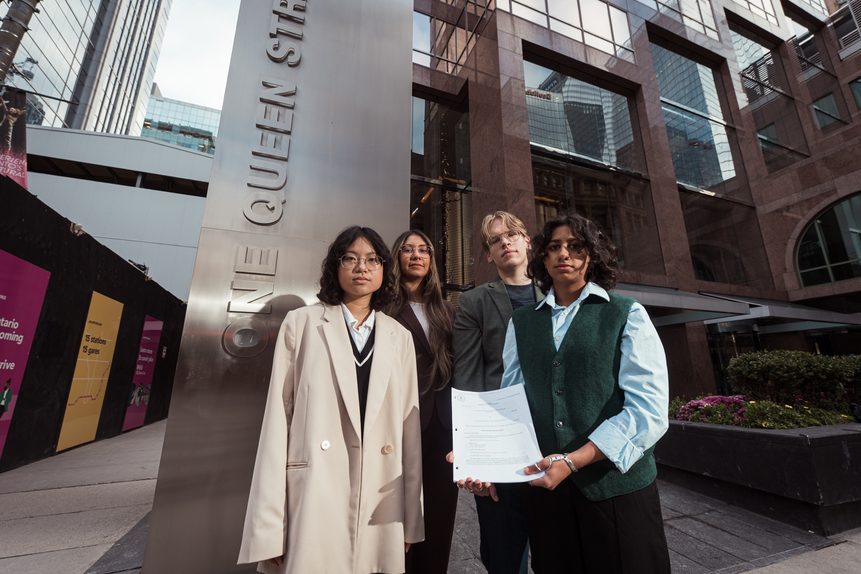
The four youth suing the Canada Pension Plan Investment Board. From left: Chloe Tse, Rav Singh, Travis Olson, and Aliya Hirji (Photo Credit: Andrew Jehan, Joshua Best, Ecojustice)
To learn more about the lawsuit, and climate change and pension plans read Suing Canada’s largest pension investment manager over alleged climate risk mismanagement (Ecojustice) and Four young Canadians take CPPIB to court to protect their pensions from climate risk (Shift).
Rav Singh (she/her) is a young farmer in southern Ontario and currently works with the Ecological Farmers Association of Ontario to support BIPOC farmers. Before farming, Rav was an environmental educator working with youth in the city on climate advocacy projects. She believes in the power of collective action, and in recent years has focused on the development of climate education materials for newcomers, farmland protection, and supporting youth entering agriculture.
