NFUniversity: Climate Class—Can the Biosphere Fuel Us?
What are the implications of scaling up biofuel production? Can we do so while also feeding a growing population? What are the climate and environmental and human rights implications? Is
What are the implications of scaling up biofuel production? Can we do so while also feeding a growing population? What are the climate and environmental and human rights implications? Is
For more information and to sign-up: click here.
Join Darrin Qualman NFU Director of Climate Crisis Policy and Action for a deep dive into the sources of agricultural emissions. For the full description and registration, click here.
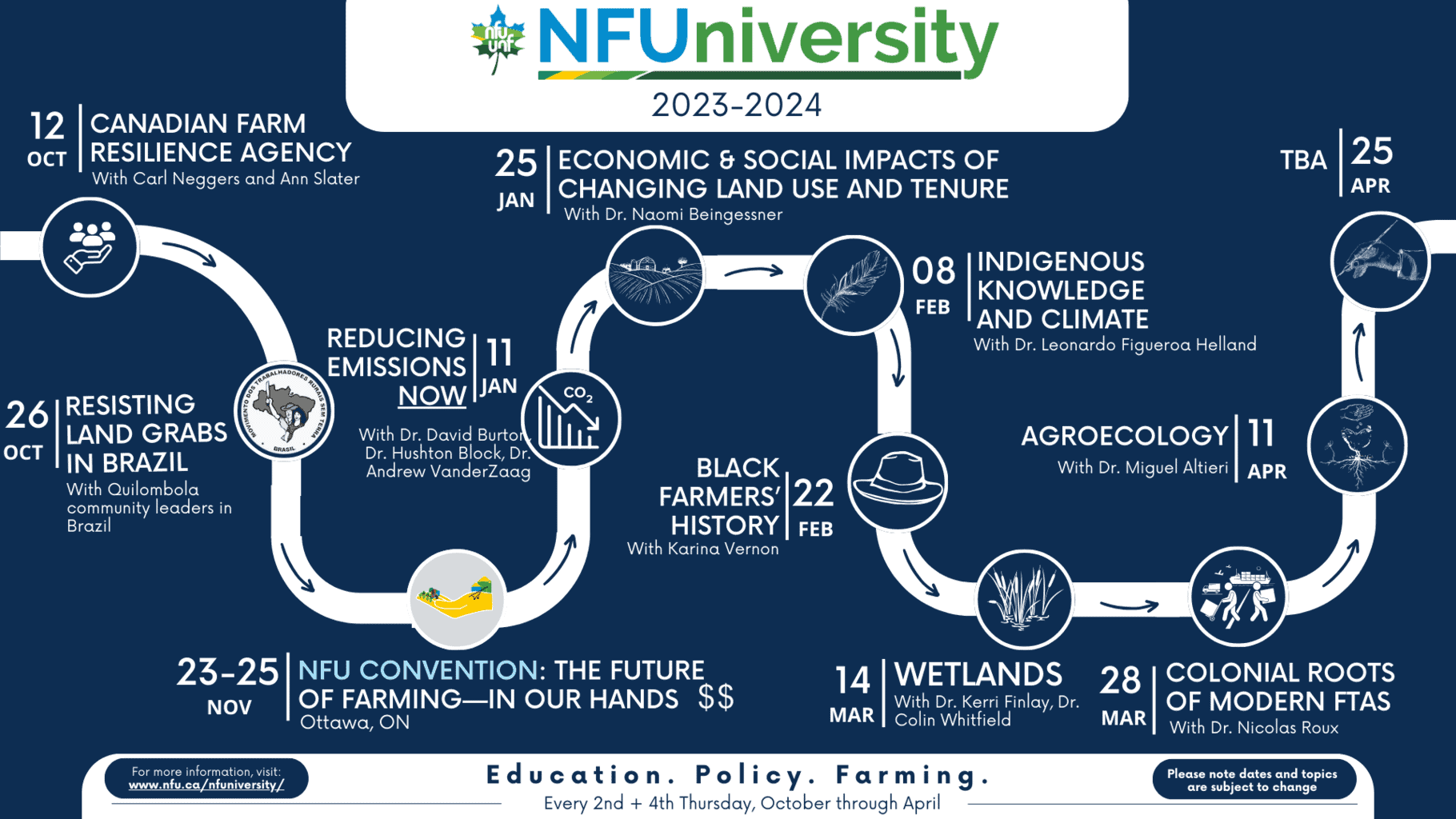
What is the relationship between economic progress in the land now called Canada and the exploitation of Indigenous peoples? And what gifts embedded within Indigenous world views speak to miyo- pimâtisiwin ᒥᔪ ᐱᒫᑎᓯᐃᐧᐣ (the good life) and specifically to good economic relations? Upholding Indigenous Economic Relationships draws on the knowledge systems of the nehiyawak ᓀᐦᐃᔭᐊᐧᐠ (Plains Cree people) to explain settler colonialism through the lens of economic exploitation.
Momentum is building for on-farm emissions reductions. Farmers face an array of options. But what is practical and cost-effective now? What four or five things should farmers consider in the
Companies and individuals are increasingly seeking to buy land in Scotland to benefit from its ‘offsetting’ potential, while farmers and landowners are being asked to increase the positive environmental impact
What do Indigenous perspectives tell us about interlocking Earth crises like climate change, biodiversity loss, and food injustice, and ways to respond to these? How can work on climate, food and sustainability center Indigenous knowledges in ways that foreground Indigenous peoples' decolonial struggles for land defense and land rematriation, biocultural diversity restoration, and the restitution of land-based sovereignty--including food sovereignty?
In the popular imagination, agriculture is often seen as a site of oppression and exploitation of Black people. However, Karina Vernon’s talk reveals agriculture as an important but under-celebrated site of resistance and freedom for Black people in Canada.
Wetlands are crucial centers of biodiversity. But in many parts of the country we are draining, plowing, and destroying wetlands. And when we do, they release greenhouse gasses. How can we protect wetlands and make that protection a core part of efforts to reduce emissions and increase biodiversity?
This talk explores the colonial origins of modern international trade. Since the 1990s, the World Trade Organization, bilateral investment treaties, and free trade agreements have governed the international trade and investment regime based on free market ideology, but geopolitics, power relations, and corporate interests have shaped trade rules for over 500 years before they reached their current form.

The National Farmers Union / L’Union Nationale des Fermiers is unique among farm organizations: we advocate for people’s interests against corporate control of our food system.
To support the NFU’s work, join or donate.