Thank you, Molly [McCracken. Director of the Canadian Centre for Policy Alternatives – Manitoba office], for such kind words. You don’t hear those kind words too often in rural Manitoba. Often, the name Fred Tait is two four-letter words. But when I received the word that the Farmers’ Union was going to be honoured today, my first thoughts went back to those that started this movement. It first started in the 1950s, the Manitoba Farmers Union, then merged into the National Farmers Union in 1969. And that group that started this movement set a foundation that we still stand on. And without them, I wouldn’t be here today accepting the honour really on their behalf.
I also note the similarity between the National Farmers Union and the Centre for Policy Alternatives. In the environment that we function today, we are continually told that the solution to all the social and economic problems we face, we must produce more. Well, the Farmers’ Union has shown some time ago, the more we produce, the poorer we became. That’s a hard argument to make and have people understand. So, what we did is we took all the statistics from Statistics Canada from 1926 until today and we produced a graph that shows that the more we produced, the poorer we became.
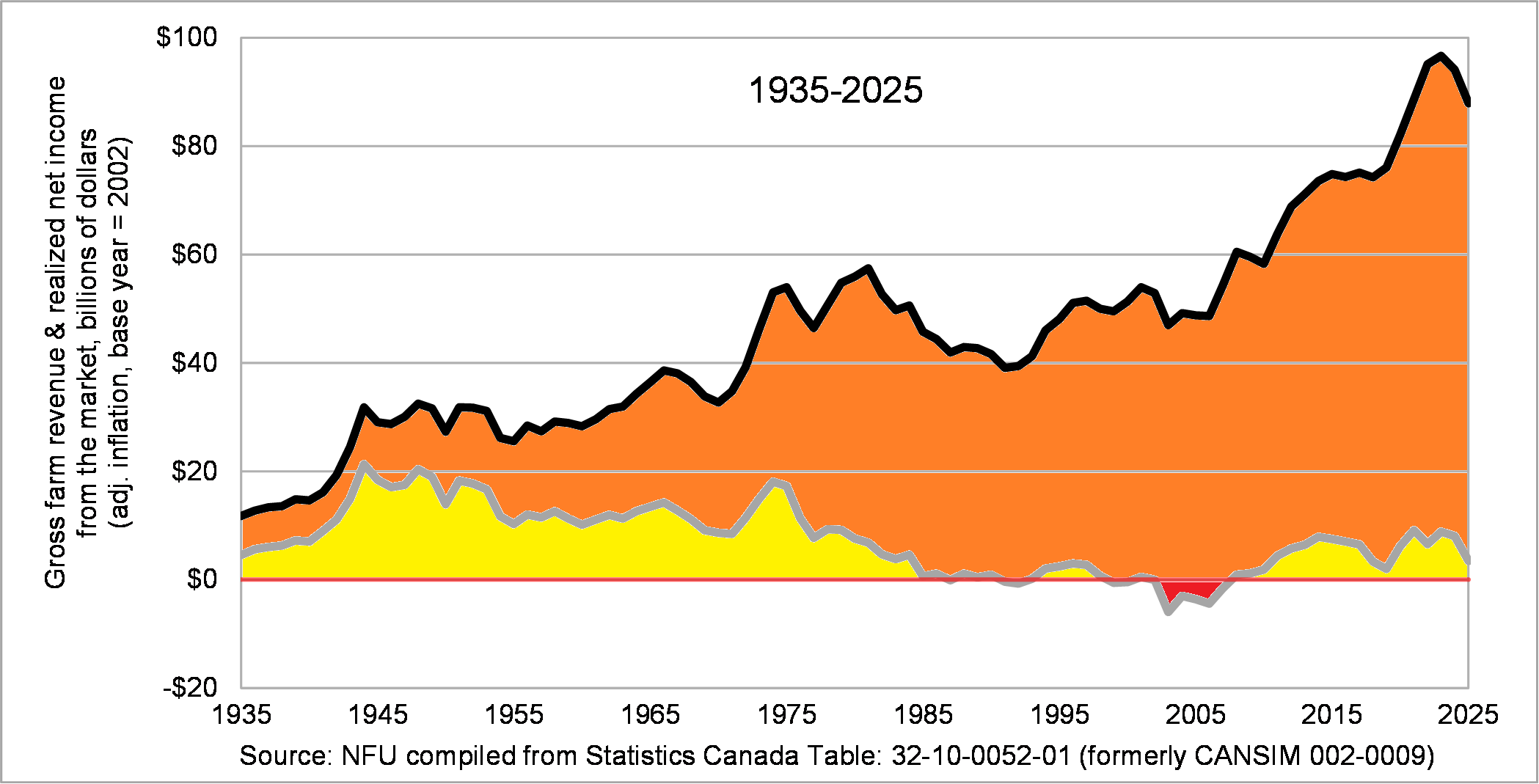
And you won’t find that graph in mainstream media. You won’t find that graph has been taught in the agricultural diploma courses. You won’t find that graph as part of the Agricultural Minister’s annual meetings. But that graph we brought up here today is on the back of the program on your table. And it shows the truth of producing more for less. It explains in simple pictures what cannot be explained in words. And when we think about the rural communities that I’m part of, we are a small part of a community that has other views. And that community, particularly since COVID, seems to have become more extreme. The caravan to Ottawa was part of that. And, of course, the economic stress that they’re working under causes them to react. And they react, not against those that were taking their wealth, but they react against those who have no connection to taking their money. They will react and speak out against people on social assistance, Indigenous people, other minority groups in society. Because they cannot face the truth. Because if they’re going to campaign – they have always thought that they need less government. We want to be free from government. They said we want less regulation. We want the Canadian Food Inspection to back away. We want environmental regulations removed so we can get on with the job, they say. But of course, as they get poorer, they have not recognized that you will either be governed by people you elect through their provincial and federal elections, or you will be governed by people who are appointed directors of the boards of corporations.
And today, agriculture is increasingly governed by the decision of corporations. The corporations that supply our imports, the corporations that supply our feed, our herbicides, our technologies. They priced it out of access to those to capture the wealth that they’re producing. And in case they should miss something, the same corporations also accept the produce that we produce. And in such a system, it’s not an accident that the graph is what it is. But it gets even worse than that. The corporations also offer what they call a delivery contract. And you can contract your production. Farmers contract their production sometimes before the crop is in the ground because they want to guarantee that they will have some income. And that contract says that they will deliver a certain quantity, at a certain price, at a certain quality. And if nature interferes with that, as it often does, and the farmer cannot supply what he has contracted, then the farmer must pay the corporation for what he could not deliver. Such a system of usury one would extent perhaps in the feudal system of a century or more ago, but it’s with us here today. And when my former Minister of Agriculture, Billy Uruski, and I looked at this issue, and we suggested perhaps we should look at this as a society. Perhaps we should have the Minister of Agriculture, the Department of Corporate and Consumer Affairs draw up a contract that would balance the risk so the farmer wouldn’t absorb it all. When I presented this idea to the Minister of Agriculture he said, no Fred, if I did that, the grain companies would be in my office and they’d be mad as hell. I said, if that happened, I’d be very pleased. I haven’t heard of any disturbances in the Ministers office.
But we also work in an environment that is extremely difficult. Undoubtedly, it is our mission, and we are a minority of rural Manitoba. Our colleagues have voted Conservative now for 65 years and counting, but there is another issue. Farm organizations revolve around commodities. We have the corn growers, we have the canola growers, we have flax growers, we have pulse growers, we have meat producers, we have Keystone Agriculture Producers, our general farm organization. Every one of those organizations is funded from a source of funding that the government of Manitoba gives them, the ability to collect funds from the sales of agriculture production. Collectively, they collect millions of dollars annually. And they use that fund to maintain and support status quo. They use that to eliminate any opposition that appears. They’ll immediately attack anybody that points out that this system is not working. But there is one organization that is not a recipient of these funds. That’s the National Farmers’ Union. We have received nothing from that. And I can understand that if I look at this issue from the perspective of Brian Pallister or Gary Filmon. I can see the merit that they would see in having a system of collecting funds that would support and maintain conservative organizations of rural Manitoba. Because these organizations of corporate agriculture are also really only extensions of the PC caucus and they help enforce the conservative stranglehold of rural Manitoba.
But what I don’t understand, I don’t understand the logic of the governments of Gary Doer and Selinger and now of Wab Kinew, of maintaining that same structure denies the most progressive voice in Manitoba from being able to participate in the democratic process.This is not an attack upon the Farmers’ Union, it is an attack on democracy itself when you fund only one side of the political debate. All looks well if you’re not involved in the ground level of agriculture. If you were to drive past – last week of July, first week of August – and go west on the Trans-Canada Highway. As you passed over the Assiniboine river bridge you would have saw spread out before you, a panorama of wealth that immersed the soil that almost defied description. And you would notice that there would be signs along some of those fields. It would be on the fields of canola, the fields of soybeans, on the soil of corn. It would identify the plant breeder that had provided the seeds. But of course there was other signs that weren’t there, that are missing, that are important. There was the word from Manitoba Agriculture, released in January of 2025, saying that under normal growing conditions, Manitobans would expect negative income for all that wealth that lay out on that prairie. Negative income. And there’s another sign that’s missing. And that is that the first farmer that rented that seed to grow those beautiful crops of corn and of soybeans paid $110 an acre for the privilege of renting that seed for one year. He paid$110 last year and he’ll pay $110 next year. And for the canola he paid $80 a acre. I believe the cost of providing that seed probably did not exceed $20, $25 an acre, and I’m probably generous there. The rest of it, my friends, was corporate taxation. Corporate taxation upon a food supply, on the very basics of agriculture. And yet at a time when everyone says what we need is tax cuts, we have to have tax cuts because of the affordability crisis. Well any time we vacate a place (the government steps aside), that place is then occupied by corporations and they apply their taxation. And that, my friend, is what we have here. And it is in the interests, of course, of corporations to pursue that.Cause greater hardship, cause greater pain, cause greater anxiety.
Because we’ve had a period now that is different from that period from after the First World War up until 1939. In that time of adversity, people turned to the left for answers. Today, they are turning to the right for answers. So it is in the interest of the corporations that things should get much worse because the electorate will turn to the right and enhance the corporation’s ability to collect its taxes from our society. Until we see that and reverse that, there is no room for us. But I also want to talk to how these utility groups that are so well funded, they do serve a utility purpose. I believe we are very close now to an announcement that we’re going to build a major plant at Portage-la-Prairie to turn food into aviation fuel. The Farmer’s Union has very severe misgivings about that. But when the announcement day comes, I am quite sure that the commodity groups will be invited, they will all attend, and they will all praise the wisdom of a government that would provide another market for agriculture products and how wealth and prosperity can’t be far away from us. The Farmers’ Union will be relegated to the sidelines. And we will point out that nothing really has changed. The same corporations that supply our inputs and capture all our wealth, the big corporations that take our output and buy their taxation. And so, at times, a person has trouble describing these things without reverting to four letter words.But enough now of the negative side of this. When things get really difficult and sometimes I tell you it is close to despair, I tend to look back to the words of the greatest Canadian (Tommy Douglas) when he said, “courage my friends, it is not too late to build a better world”. And I can tell you from my decades of experience, there is more commitment, there is more capacity, there is more ability in this room today to create a food supply that serves the needs of farmers and consumers alike than there is in the entire department of Manitoba Agriculture.
But as the greatest Canadian, he also offered us, in a world that is so full of darkness and despair, is it not better to keep alive a small flickering candle of hope than to sit and curse the darkness. Well, there have been moments this past year when I would turn on my CBC radio in the morning and I would hear Molly McCracken doing an interview about the social and economic injustices of our time. And the thing that impressed me was the calmness in Molly’s voice. It wasn’t the words, it was the light that the words cast into the darkest corners. And you add the work of our provincial office. You add the word of our national office. You add the CCPA Monitor. You add the alternative budgets. And you add the absolutely incredible work of Darrin Qualman over the 19 years that he was employed with the Farmers Union, exposing the farcical system that we call competitive capitalist agriculture. And I have to say, I was proud when I heard Molly speak on our behalf. But the greatest Canadian, he also said, my friends, dream no little dreams. And when I think of those words, I’m reminded of 106 years ago, this past June. The little people of Winnipeg, they came out on the streets and they were carrying with them their dreams of a better world and the ability to bargain collectively, of health care, of better distribution of a nation’s wealth. And we know the story of how the RCMP came that day and they drove the little people off the streets. But those little people, they did not leave their dreams on the streets that day. They took them home with them, they nourished them, they shared them with others. And they waited patiently, and it was 25 years later, the little people’s dreams, they emerged once more. They emerged in the words of a speech from the throne of the legislature of the first government led by the greatest Canadian. The lesson there is never abandon your dreams. And what happened here in 1919 has forever changed this province.
And in the 90th anniversary of the 1919 strike, there was a great celebration and there was great number of organizations that participated. The Farmers’ Union was there. I was there. And I was proud to be part of that group of progressive people that were moving towards a better world. We were there again on the 100th anniversary and we were the only farm organization there, by the way. Because the Farmers’ Union, we’re not about grains and trains, we’re about people and places and the environment, and all the things that make civilized and livable society. And we were there when we championed the cause of marital property rights. We were there for the cause of gender equality. In fact, it’s part of our constitution that governs the whole organization. And we were there in the battle to support the creation of public health care and we are there yet today to defend it. We were there to defend the rights of temporary foreign workers to be treated as Canadians. We were here to lead the battle that we have to do something about climate change. We were there when apartheid was an issue in South Africa, and we are here today as apartheid continues in the Gaza strip. This journey has been longer, perhaps, than I ever would have imagined.
I began this journey in this world in February of 1942, which is quite a time ago now. And I have to tell you, in my youth and my impatience, I was sure that it wouldn’t be long that we would find the road to that better world. But I now realize that this journey is a journey of a lifetime. And I can’t tell you how much further it is to that better world. But I can tell you for certain who will be there to lead the way. And they will be found in the membership of the Farmer’s Union and the CCPA. They will lead the way. They have always led the way. I can describe to you what will that other better world will be. In that better world, the words of poverty and homeless and hunger will be no more. They will be words that describe the history of another time and another place. And we will get to that better place. And when we get to that better place, then corporate control of agriculture will be no more. There will be a food program that is controlled by people, and farmers will have a contract to supply the food to feed a nation. And in return we shall have a contract that will be honourable, to undo the damage that corporate agriculture has done in creating an agricultural desert. We will repair that, we’ll restore the communities. And of course, there will be that great connective graph that describe what has happened. It will become part of the education curriculum. It will be taught, and it will be displayed in public places. And it will be a reminder to future generations the fallacy of allowing corporations to gain control of their food supply.
So I say, my friends, let us dream no little dreams, and let us again continue with our lifetime journey that will lead us to a better world. And I must now thank you for recognizing the role that Farmers’ Union has been able to play along that long road. And tomorrow, those of us that have came from outside the city, we will return to those places called Tilston, and Deleau, and Gilbert Plains, and Beausejour, and Lowe Farm, and Rossendale, and all the places between. But we will tomorrow morning, we will again continue that journey that will eventually lead us to a better world. Thank you so much.
